

Why does professional epoxy cost more than a store-bought kit?


A professional epoxy flooring cost estimate often looks high beside a retail kit priced at a few hundred dollars. The comparison feels simple, yet the two prices cover different purchases.
A store-bought kit supplies coating and basic instructions. A professional quote covers slab inspection, mechanical preparation, repairs, system design, commercial equipment, trained labor, cure management, and written responsibility for the finished floor.
Professional installation costs more because reliable adhesion starts below the visible finish. You pay for the work required to prepare your concrete, select compatible materials, apply each layer within strict timing limits, and reduce the risk of peeling, blistering, hot-tire pickup, or early wear.
You Are Comparing a Product With a Complete Flooring System
A retail kit usually includes resin, hardener, decorative flakes, etching material, and directions. Your purchase ends at the box. You remain responsible for cleaning, testing, repairs, equipment, application, and any failed result.
A professional system starts with the slab. The installer evaluates old coatings, oil contamination, sealers, curing compounds, cracks, joints, moisture, sunlight, traffic, and chemical exposure. Those findings determine the preparation method and coating build.
A fair comparison includes grinder rental, diamond tooling, edge work, dust extraction, crack repair, moisture testing, primer, topcoat, protective equipment, disposal, and your labor. It also includes removal and regrinding if the first coating fails.
Cost factor | Store-bought kit | Professional system | Why it matters |
Slab inspection | Owner judgment | On-site evaluation | The coating must match the slab |
Surface preparation | Cleaning or etching | Grinding or shot blasting | Adhesion depends on surface profile |
Repairs | Separate purchase | Specified repair process | Cracks and joints need different treatment |
Coating build | Often one main coat | Primer, body coat, broadcast, topcoat | Each layer performs a separate job |
Responsibility | Owner | Installing contractor | Written coverage assigns responsibility |
Heavenly Touch Stone Care evaluates the whole floor before recommending a coating system.
Professional Preparation Creates the Bond
Most coating failures start at the concrete-to-primer bond. A clean-looking slab still might be too smooth, sealed, contaminated, weak, or damp for dependable adhesion.
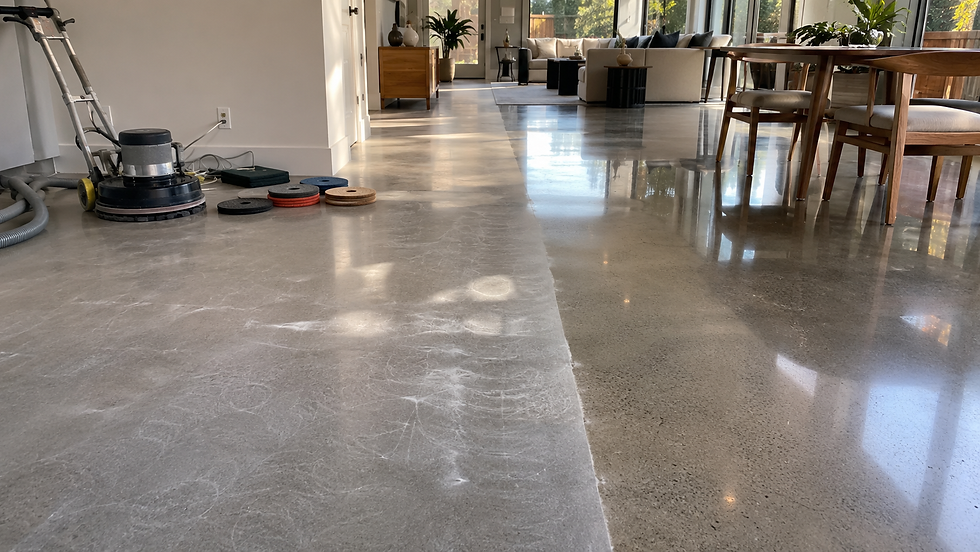
Professional preparation removes material. Cleaning removes loose dirt. Degreasing addresses oil. Acid etching reacts with exposed cement paste, yet it does not remove every sealer, old coating, hard-troweled surface, or deep contaminant. Diamond grinding cuts into the slab, removes weak material, and creates a controlled profile.
The ICRI concrete surface preparation guideline uses Concrete Surface Profile benchmarks for specification and verification. A coating manufacturer might call for CSP 2, CSP 3, or CSP 4. The required profile depends on system thickness and service conditions.
Grit numbers do not equal CSP numbers. A crew might begin with 16-, 25-, or 30-grit metal-bond tooling for coating removal, then change tooling after checking hardness and surface response. Medium concrete often falls near Mohs 3 to 5. Hard concrete often falls near Mohs 5 to 8. Extremely hard concrete reaches Mohs 8 to 10. Tool bond selection changes with hardness because hard slabs need diamonds kept exposed, while soft slabs wear tooling faster.
Edges, corners, thresholds, and fixed objects need separate passes. Skipped edges often become the first peeling points.
Professional epoxy floor coatings should start with a preparation plan tied to the slab and product requirements.
Moisture, Cracks, and Joints Change the Price
Concrete moisture is not judged by appearance. A slab might look dry while moisture moves through its pores.
There is no responsible San Jose-wide concrete moisture PPM figure. Epoxy specifications usually rely on internal relative humidity, shown as a percentage, or moisture vapor emission rate, shown as pounds per 1,000 square feet over 24 hours. PPM is not the standard field unit for this decision.
ASTM F2170 relative humidity testing measures internal slab moisture with in-situ probes. ASTM links excessive moisture with debonding and coating deterioration. Results represent conditions at tested locations and at the time of testing.
A product rating is not a universal approval limit. One moisture-tolerant commercial primer lists tolerance up to 97 percent RH or 15 pounds of vapor emission. Another coating might require a lower reading. The installer must follow the selected system’s technical data.
Cracks also need classification. A static crack often receives routing, cleaning, and repair material. A moving crack might return through a rigid coating. Control joints and expansion joints often need flexible treatment or continued movement space.
The USGS Northern Santa Clara Valley maps show regional ground conditions vary sharply and do not replace site-specific evaluation.
Concrete polishing and surface preparation experience helps identify weak paste, contamination, old sealers, and uneven hardness before resin application.
Professional Materials Form a Layered System
Customers often call the whole floor epoxy even when several chemistries form the finished system.
A typical professional build might include a penetrating primer, high-build epoxy body coat, decorative flake or quartz, and a polyaspartic or polyurethane topcoat. Primer supports adhesion. The body coat provides build and color. Broadcast material adds texture and coverage. The topcoat helps resist abrasion, chemicals, and sunlight.
Retail data gives useful context. One water-based garage kit lists roughly 52.6 to 52.8 percent solids by volume and about 3.0 to 3.5 mils of dry film per coat. A wet film loses thickness as water or solvent leaves during cure. A 100 percent solids system retains more wet thickness, yet solids content alone does not prove quality.
Mix ratio, batch size, induction period, pot life, recoat window, slab temperature, and room temperature all affect installation. Sherwin-Williams notes some commercial epoxy blends offer about 15 minutes of placement time, while other formulas provide 30 to 40 minutes or longer. Recoat windows often fall between four and 24 hours.
Cure times also differ. One retail garage product lists foot traffic after one to two days and vehicle traffic after three days. One industrial 100 percent solids epoxy lists light traffic after 12 to 16 hours and vehicle traffic after 36 to 48 hours. These are product examples, not universal promises.
Labor and Equipment Pay for Process Control
Epoxy installation is controlled chemical work. Once resin and hardener meet, the reaction begins. The crew must place the material before pot life expires, maintain coverage, keep a wet edge, broadcast flakes evenly, and apply later layers inside the approved recoat window.
Professional equipment includes planetary grinders, edge grinders, HEPA dust extractors, hardness picks, moisture probes, mixing stations, gauged squeegees, wet-film gauges, spike shoes, and broadcast equipment. Ownership also includes transport, maintenance, worn diamond segments, filters, electrical setup, cleanup, and disposal.
Crew coordination matters. One person mixes while another spreads material and another back-rolls or broadcasts aggregate. Poor timing produces roller lines, uneven flakes, soft spots, pinholes, trapped air, weak intercoat adhesion, or gloss variation.
San Jose temperature swings affect working time. Warm resin reacts faster. Cool conditions slow cure. Slab temperature matters because concrete stores heat. Dew-point conditions matter too. Condensation on a cool slab creates a poor bonding surface even when the air feels dry.
Professional installation also includes clear instructions for foot traffic, vehicle return, ventilation, cleaning, and replacing stored items. Product-specific guidance outranks a generic same-day promise.
The Heavenly Touch flooring FAQs provide added guidance for planning a concrete coating project.
The Higher Price Reduces Failure Risk and Assigns Responsibility
A failed coating costs more than a replacement bucket. Removal often requires clearing the space again, grinding away the failed film, disposing of debris, correcting the original slab problem, and installing a second system.
Common failures include peeling, hot-tire pickup, blistering, delamination, UV ambering, worn traffic lanes, soft spots, uneven gloss, and cracks telegraphing through the finish.
A thick 100 percent solids epoxy still fails over smooth, contaminated, weak, or moisture-stressed concrete. A polyaspartic topcoat does not repair a poor bond beneath it. The full system is only as strong as slab preparation, primer adhesion, layer compatibility, cure timing, and joint treatment.
Warranty value depends on written terms. Ask whether coverage includes peeling, hot-tire pickup, labor, materials, and inspection. Ask about exclusions for moisture, moving cracks, abuse, sunlight, normal wear, or poor maintenance. A long warranty headline means little without clear coverage and an established contractor willing to inspect a problem.
Price comparisons should focus on expected service life, cleaning needs, chemical resistance, repair access, downtime, removal risk, and contractor accountability.
The lowest bid deserves close review when it omits slab inspection, mechanical preparation, product names, layer count, cure schedule, or written warranty terms.
How to Compare Epoxy Quotes in San Jose
Two garages with equal square footage often need different budgets. One slab might be clean, sound, and bare. Another might hold oil, hard-water deposits, paint, cracks, patchwork, or a failing coating.
Ask every contractor these questions:
What mechanical preparation is included?
Which CSP target is specified?
Which grit and bond sequence fits the slab hardness?
How will edges and thresholds be prepared?
Will moisture testing occur where conditions support it?
How will static cracks, moving cracks, and joints receive different treatment?
Which manufacturer and product names appear in the system?
How many layers are included?
What approximate dry film thickness is expected?
Is the finish UV-stable near open garage doors?
When is foot traffic allowed?
When are vehicles allowed?
What does the written warranty include and exclude?
Bay Area product selection also includes air-quality compliance. Bay Area Air District Rule 8-3 regulates architectural coating VOC content, including floor coatings. Low VOC does not equal weak performance, and high solids does not guarantee adhesion.
Watch for no site visit, no mechanical preparation, no technical data sheets, one product proposed for every layer, permanent crack promises, or same-day vehicle use without manufacturer documentation.
Conclusion: Heavenly Touch Stone Care Professionally Serves San Jose and the Greater South Bay Area

Professional epoxy costs more because you are paying for a flooring system, not a box of coating. The price covers slab diagnosis, mechanical preparation, hardness-based tooling, moisture evaluation, crack and joint work, compatible layers, trained labor, cure control, and written responsibility for the result.
The strongest value appears before the decorative finish goes down. Correct preparation creates the bond. Correct materials match traffic, sunlight, cleaning, and chemical exposure. Correct timing protects adhesion between layers. Clear warranty terms define responsibility after completion.
A retail kit still has a place for owners who accept the labor, equipment needs, and risk. A professional system is the stronger decision when long-term adhesion, consistent appearance, easier care, and contractor accountability matter.
Heavenly Touch Stone Care serves San Jose, Willow Glen, Almaden Valley, Campbell, Los Gatos, Saratoga, Santa Clara, Cupertino, Morgan Hill, and surrounding South Bay communities. Request an on-site epoxy flooring evaluation before choosing a product or accepting a quote based on square footage alone.
Frequently Asked Questions
How much does professional epoxy flooring cost per square foot?
Pricing depends on slab condition, coating removal, grinding, repairs, moisture control, layer count, finish, and service demands. An on-site inspection gives a more useful figure than a national average.
Is professional epoxy worth the higher cost?
Professional work offers stronger value when you want dependable preparation, controlled application, consistent appearance, and written accountability. A low-risk utility floor with modest expectations might support a retail approach.
How long does professional epoxy flooring last?
Service life depends on preparation, system thickness, traffic, sunlight, chemical exposure, slab movement, and maintenance. A properly designed system often serves for many years, while a poor bond shortens life regardless of material price.
Why does epoxy peel under vehicle tires?
Common causes include weak preparation, contamination, insufficient cure, moisture, thin film, or poor adhesion between layers. Heat and tire pressure expose weak areas near garage entrances.
Is diamond grinding better than acid etching?
Grinding removes old coatings, weak paste, and many surface contaminants while creating a measurable profile. Acid etching has narrower limits and does not replace mechanical removal where sealers, paint, dense concrete, or contamination remain.


Comments